
If you searched “CraxsRAT download,” you’re one of thousands of people who type that phrase into Google every month. Some are researchers trying to understand how Android malware works. Some already suspect their phone is infected and typed the name straight from a security alert. And some are genuinely looking for a free copy of the tool. Whichever group you fall into, there’s no safe download waiting at the other end of that search. CraxsRAT is malware, sold as malware-as-a-service to criminals, and every “free download” link attached to it is either a scam, a secondary infection, or bait for a legal problem you don’t want.
This article breaks down what CraxsRAT actually is, how a real cybercrime syndicate used it to steal $25 million from thousands of victims, how to tell if your device is infected, and what to do if it is.
📌 Worth knowing: CraxsRAT is not one static app. It’s an actively developed RAT builder sold to other criminals, which means each deployment can look different: different app name, different icon, different exact permission set. That’s part of why it keeps slipping past casual detection.
What Is CraxsRAT
CraxsRAT is a Remote Access Trojan built for Android devices. Its lineage traces back to Spymax, an older mobile RAT whose source code leaked publicly in 2020. A threat actor built on that leaked codebase, expanded its capabilities significantly, and began distributing improved versions through underground forums and later Telegram, positioning it as a malware-as-a-service product other criminals could rent or buy.
Once installed, CraxsRAT leans almost entirely on Android’s Accessibility Service, a feature designed to help users with disabilities interact with their screens more easily. In legitimate apps, this permission reads screen content and simulates input to assist someone who needs it. In CraxsRAT’s hands, the same permission lets an attacker read everything on your screen, log keystrokes, approve prompts on your behalf, and operate the device as if they were holding it.
Why “CraxsRAT Download” Searches Are So Dangerous
Type “CraxsRAT download” into a search engine and most of what comes back falls into three buckets. Forum posts and shady file-sharing sites offering a “cracked” or “free” copy. Blog posts explaining the malware, some genuinely educational and some thin content stuffed around ads. And, occasionally, threads from people trying to figure out why their phone is behaving strangely after installing something they shouldn’t have.
The problem is the first bucket. CraxsRAT is a paid criminal product. Nobody selling access to a working banking-fraud tool is also giving it away for free out of generosity. Sites offering a “free CraxsRAT download” are almost always doing one of three things: bundling a second piece of malware into the download, harvesting payment or personal information from the person downloading it, or handing over a broken build that infects the downloader’s own device instead of a target’s. There is no version of “downloading CraxsRAT for free” that ends well for the person clicking the link.
⚠️ Remember: There is no legitimate consumer use case for CraxsRAT. Outside of isolated, authorized malware research labs, anyone offering it to you is either scamming you directly or setting you up to commit a federal crime.
How CraxsRAT Actually Spreads
CraxsRAT doesn’t rely on some hidden vulnerability. It relies on people installing it themselves, tricked by convincing phishing. The pattern documented by cybersecurity firm Group-IB, which investigated one of the largest CraxsRAT operations on record, looked like this:
- Attackers built phishing websites cloned to look like real, familiar brands, including online shopping platforms, delivery services, and even a fake anti-scam center designed to look like it protected consumers from fraud.
- Visitors were told they needed to install an app to complete a purchase, place an order, or verify their identity.
- The app was actually an APK carrying CraxsRAT, and installing it prompted the user to grant Accessibility Service access, usually disguised behind an innocent-looking setup screen.
- Once granted, the attacker had a live remote foothold on the device.
Here’s how that four-step pattern actually looks in practice:
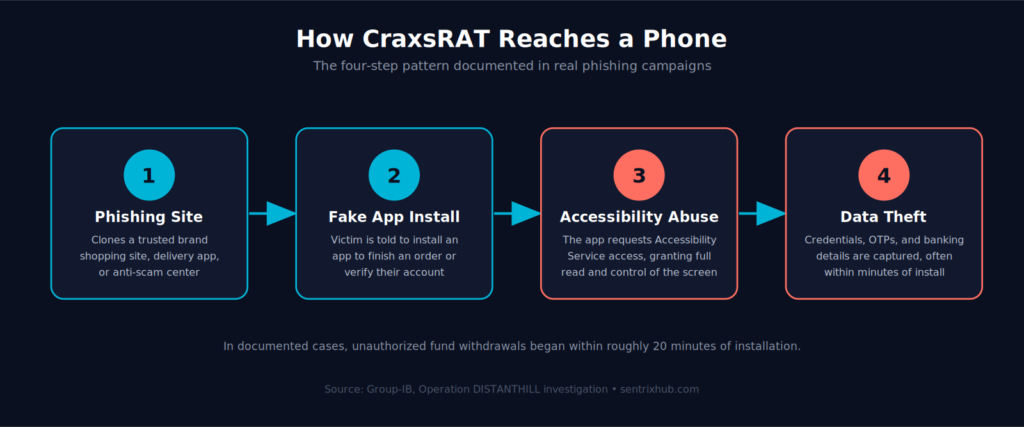
The typical path from a cloned phishing page to stolen banking data, often completed in under 20 minutes.
Group-IB’s investigation found the syndicate had used more than 250 phishing websites to distribute fake Android apps across Southeast Asia, cloning at least ten different brands ranging from online shopping platforms to a pet grooming salon and a dumpling shop. The variety wasn’t random. Choosing locally trusted, everyday brands made the fake apps far more convincing than a generic “install this app” prompt ever could be.
Inside a Real CraxsRAT Operation: The $25 Million Case
This isn’t a hypothetical threat. In 2024, law enforcement in Singapore, Hong Kong, Malaysia, and Taiwan dismantled a syndicate that had been running CraxsRAT-based fraud since April 2023. Group-IB’s High-Tech Crime Investigations team played a central role in unwinding the network, detailed in their Operation DISTANTHILL report, which used an Android RAT disguised as legitimate apps to steal more than $25 million.
The scale of the operation, once investigators mapped it out, was significant. More than 4,000 people were defrauded, with Singapore alone recording nearly 2,000 cases in 2023. Group-IB’s investigation identified over 100 command-and-control servers coordinating the malware across the region. Law enforcement dubbed the joint takedown Operation DISTANTHILL, and it uncovered 260 distinct variants of the RAT running across that infrastructure, all traced back to the same syndicate.
The operation resulted in 16 arrests across Hong Kong and Malaysia on charges of conspiracy to commit fraud and money laundering. Two of those arrested, ages 26 and 47, were identified as the operation’s primary masterminds, believed to control more than 50 of the group’s command-and-control servers between them. Investigators also traced the group’s infrastructure to a fake customer service center in Taiwan, where four additional operators were arrested and roughly $1.33 million in cash and cryptocurrency was seized.
One detail stood out during the technical investigation: the malware’s admin panel and parts of its command-and-control infrastructure used a Chinese-language interface, which is part of what led investigators to conclude Chinese-speaking threat actors were behind the campaign.
✅ Best practice: Never install an app to “complete a purchase” or “verify your account” from a link sent through SMS, WhatsApp, or a display ad. Go to the brand’s official app store listing directly instead. That one habit would have stopped nearly every victim in the case above before infection.
What CraxsRAT Can Do on an Infected Device
Once it has Accessibility Service access and a working connection to its command-and-control server, an attacker running CraxsRAT can typically:
| Capability | What It Means for the Victim |
|---|---|
| Keylogging | Every keystroke, including passwords and PINs, is recorded |
| Screen recording | The attacker can view or record everything shown on screen |
| OTP interception | SMS-based one-time passcodes are read and forwarded before the victim sees them |
| Camera and microphone access | Live audio and video surveillance without any visible indicator |
| Geolocation tracking | Continuous, precise location monitoring |
| Remote device control | Apps can be opened, closed, installed, or removed remotely |
| Persistence | The malware can survive a device reboot and keep running in the background |
This is the same underlying weakness security researchers study when reverse-engineering apps to understand how far a single overgranted permission can go. Tools built for legitimate mobile security testing, like the ones covered in our comparison of Frida versus the Xposed framework, exist precisely because this class of abuse is so effective and so hard to catch after the fact.
G700: The Next Generation of CraxsRAT
CraxsRAT hasn’t stood still. In late 2024, threat intelligence firm CYFIRMA published research on G700, an evolved variant built directly on top of the CraxsRAT codebase, this time aimed squarely at cryptocurrency users. G700 adds a “hide SMS” feature that silently redirects every incoming OTP to an attacker-controlled Telegram bot without triggering a single notification on the victim’s phone, so the person never even knows a code arrived. It also generates convincing fake Google Play Store pages to push its malicious APK, and its developer has advertised versions with the ability to inject fake transaction screens for apps like Trust Wallet, tricking victims into approving transfers to the attacker’s wallet instead of their own.
The “hide SMS” feature works like this, start to finish:
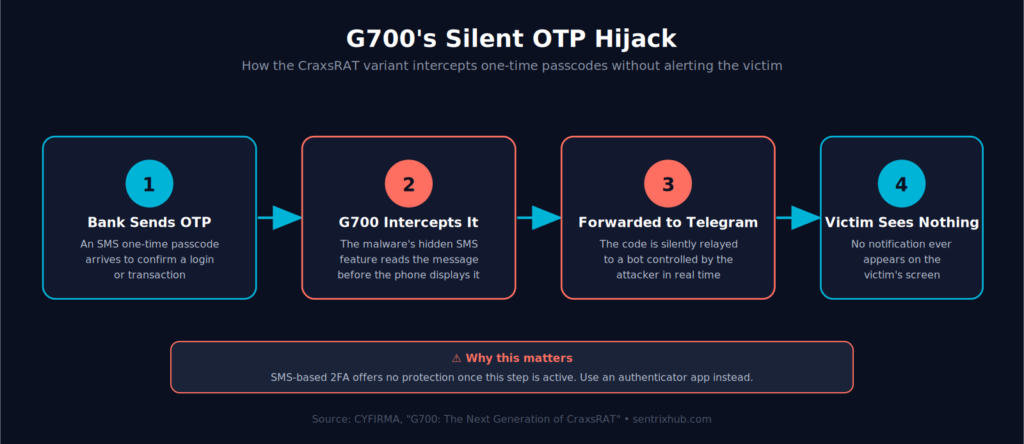
G700’s hidden SMS feature relays OTPs to the attacker in real time without ever notifying the victim.
Running that same G700 sample hash through VirusTotal confirms exactly how this connects back to older malware families:
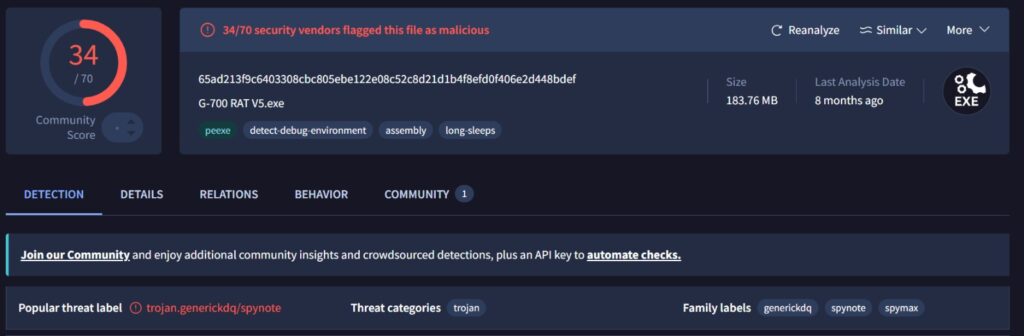
A G700 sample (hash sourced from CYFIRMA’s published IOC list) flagged by 34 of 70 security vendors on VirusTotal, with family labels confirming its SpyNote/SpyMax lineage.
The pattern here matters more than the specific variant name. Whoever is behind CraxsRAT keeps shipping updates and selling them, sometimes for a few hundred dollars, sometimes for a lifetime license running into the thousands, through Telegram groups with thousands of subscribers. That’s the malware-as-a-service model in action: one piece of code, endlessly repackaged and resold to whoever’s willing to pay.
Is CraxsRAT Illegal?
Yes, without exception for unauthorized use. In the United States, deploying CraxsRAT against a device you don’t own and don’t have explicit written authorization to access violates the Computer Fraud and Abuse Act (CFAA), which criminalizes unauthorized access to protected computer systems, a category that includes smartphones. Similar laws apply internationally: the Computer Misuse Act in the UK, and comparable cybercrime statutes across the EU and Asia.
The consequences aren’t abstract. In the Operation DISTANTHILL case, the two identified masterminds faced prison terms of up to seven and ten years respectively, along with fines reaching $500,000. “Just testing it on a friend’s phone” doesn’t create an exception. Without documented, written consent from the device owner, installing a RAT on someone else’s phone is a criminal act regardless of the stated intent behind it.
Signs Your Device May Be Infected
Watch for a combination of these, especially after installing an app from outside the official app store:
- Battery draining noticeably faster than normal, particularly with the screen off
- A spike in mobile data usage that doesn’t match your actual activity
- Apps in your app drawer that you don’t remember installing, sometimes with generic names like “System Update” or “Security Patch”
- The camera or microphone activating without you opening an app that uses them
- Login alerts or password reset emails you didn’t request
- Missing one-time passcode texts, since the malware intercepts them before you see them
CraxsRAT Removal Guide
If you suspect infection, treat it as active and move quickly rather than waiting for more confirmation. The first thing to do is disconnect: turn off Wi-Fi and mobile data right away. That single step cuts the connection to the attacker’s command-and-control server and stops further data theft while you work through the rest of this.
From there, boot into Safe Mode, which stops third-party apps, including the malware, from running. On most Android phones you press and hold the power button, then press and hold “Power Off” until the option to reboot into Safe Mode shows up. Once you’re in Safe Mode, head to Settings > Security > Device Admin Apps and revoke admin rights from anything unfamiliar. This matters more than it sounds like it should, since malicious apps often request device admin access specifically so they can’t be uninstalled the normal way.
With admin access revoked, go to Settings > Apps and remove whatever you don’t recognize or don’t remember installing. Clear the device’s cache while you’re in there, and follow up with a scan from a reputable mobile security app to catch anything left behind.
Passwords come next, and this is the step people tend to rush. Assume anything typed on the infected phone is compromised, not just the accounts you’re worried about. Change email, banking, and anything tied to SMS-based recovery, and do it from a different, clean device. A tool like our passphrase generator speeds this up, and running the new passwords through a password strength check before you commit to them is worth the extra minute.
Reboot the phone normally once you’re confident it’s clean, and keep half an eye on battery life, data usage, and your bank statements for the next few weeks. If the device had access to banking apps or sensitive work accounts, call your bank about potential fraud right away, and if anything still feels off after the manual cleanup, a full factory reset is the safer call than assuming it’s fine.
Legitimate Alternatives, Depending on What You Actually Need
If the reason you searched for CraxsRAT wasn’t malicious but you’re just not sure what the legitimate tool for your situation actually is, that’s a fair problem to have. It usually comes down to one of three needs.
If you’re managing company-owned devices, you don’t need a RAT at all. Google’s Android Enterprise tools, Microsoft Intune, or any dedicated mobile device management platform will give your IT team remote wipe, app control, and policy enforcement, and none of it carries the legal exposure that comes with deploying a trojan. Vendors like Appdome go a step further and build detection specifically for RATs and accessibility-service abuse into the apps themselves, which is worth a look if you’re shipping a banking or fintech app and want to harden it against exactly this kind of threat.
Helping a family member fix something on their phone remotely is a completely different situation, and it has an easy answer: TeamViewer QuickSupport, AnyDesk, or Chrome Remote Desktop. All three let the other person see exactly what you’re doing and end the session whenever they want, which is the opposite of how CraxsRAT operates.
And if you’re actually trying to learn how Android malware works, good, that’s a legitimate interest, just keep it off your personal device. Set up an isolated lab instead, whether that’s Android Studio’s emulator or a dedicated test phone with no personal accounts on it. Our mobile app security checklist is a decent starting point for structuring that kind of research without putting your own data at risk.
Prevention: What Actually Stops This
- Never sideload APKs from links in texts, ads, or unofficial websites, no matter how convincing the page looks
- Review app permissions before installing; a shopping app has no legitimate reason to request Accessibility Service access
- Keep Android and all apps updated, since security patches close the gaps malware depends on
- Leave Google Play Protect enabled
- Use an authenticator app instead of SMS for two-factor authentication where possible, since SMS codes are exactly what CraxsRAT is built to intercept
- Check our login security checklist for a fuller rundown of account-level protections that reduce what an attacker can do even if a device is briefly compromised
📌 Worth knowing: The same overgranted-permission pattern that makes CraxsRAT effective on phones shows up constantly in weak file permission issues on servers and desktop systems. Excessive access, once granted, is almost always the real vulnerability, not the malware itself.
Frequently Asked Questions
Is CraxsRAT a virus or a legitimate remote access tool?
It’s malware. The underlying idea of remote access isn’t inherently malicious, but CraxsRAT is built and sold specifically for unauthorized surveillance and financial fraud. There’s no legitimate consumer version of it.
Can my phone get infected without me installing anything?
No. CraxsRAT requires the victim to install a malicious APK. The infection always starts with a user action, but that action is often the result of convincing, well-targeted phishing rather than carelessness.
Will a factory reset remove it completely?
Generally yes, as long as you don’t restore from a backup that includes the malicious app. Perform a clean reset and reinstall apps manually from the official store afterward.
Is downloading CraxsRAT for “research purposes” illegal?
Intent matters less than most people assume. Downloading and running malware without proper authorization and an isolated environment carries legal risk regardless of stated purpose. Use established, legal frameworks like Metasploit in a controlled lab instead.
The Bottom Line
The Operation DISTANTHILL case shows exactly what “CraxsRAT download” actually leads to when it’s used the way it’s designed to be used: over $25 million stolen from more than 4,000 people, a criminal network spanning four countries, and prison sentences for the people running it. If you searched for a download link, what you actually need is either the removal steps above, if you’re already infected, or one of the legitimate alternatives, if you have a real remote access need. Neither one involves downloading this malware.

Abdul Shakoor writes practical, defensive cybersecurity and networking guides for SentrixHub. He focuses on making API security, mobile app security, authentication, and network concepts simple for beginners and developers.