
Is an IP stresser illegal to use? In nearly every real-world case, yes. Most services advertised as “IP stressers” or “booters” today aren’t legitimate testing tools with a legal gray area attached. They’re DDoS-for-hire infrastructure, and law enforcement across multiple countries is actively dismantling them and pursuing their users, not just their operators., and the longer answer is more useful than the short one. Most services advertised as “IP stressers” or “booters” today aren’t legitimate testing tools with a legal gray area attached. They’re DDoS-for-hire infrastructure, and law enforcement across multiple countries is actively dismantling them and pursuing their users, not just their operators.
This guide breaks down what these services actually are, why the “stress testing” label is misleading, and what genuinely happens to people who get caught using one.
Key takeaways:
- Authorization is the entire legal question: testing your own server is legal, testing anyone else’s without written permission is a crime in most countries.
- A multi-year international law enforcement effort called Operation PowerOFF has seized over 100 booter domains and is now going after individual users, not just operators.
- Consequences range from criminal charges and civil lawsuits to ISP termination and a permanent record, even if you never get personally arrested.
- Legitimate load testing tools exist and are free: JMeter, k6, Locust, Gatling, Vegeta, and Artillery all test infrastructure you actually own.
What Is an IP Stresser?
An IP stresser is a web-based service that sends a flood of traffic at a target IP address or domain, intended to knock it offline. Many of these sites market themselves using the language of legitimate network testing, phrases like “stress test your network” or “check your server’s resilience”, while functioning as DDoS-for-hire platforms once you look at how customers actually use them.
The distinction matters legally. A tool that floods traffic at infrastructure you own and have permission to test is a stress tester. The exact same tool, pointed at someone else’s server without their consent, is a weapon used to commit a distributed denial-of-service attack. The software rarely changes. The authorization does.
📌 What actually separates a legal test from a crime: It isn’t the traffic pattern, the software, or even the volume of data sent. It’s a single question: did the owner of that infrastructure give you documented permission to run this? Everything else in this article follows from that one line.
Legitimate Stress Testing vs a Booter Service
| Legitimate Stress Testing | Booter/Stresser Service | |
|---|---|---|
| Target | Infrastructure you own or have written authorization to test | Any IP address a paying customer enters |
| Consent | Explicit, documented | None required |
| Purpose | Measure your own system’s capacity | Take a target offline |
| Typical tools | JMeter, k6, Locust, Gatling | Web dashboard, enter IP and pay |
| Legal status | Legal | Illegal in most jurisdictions |
| Who’s liable | No one, it’s your own system | The person who launched the attack, and sometimes the service operator |
Why Almost Every Public “IP Stresser” Is Illegal
The core issue isn’t the traffic itself. It’s who authorized it. Sending a flood of packets at your own home lab server is completely legal. Sending that same flood at a stranger’s website, a competitor’s server, or a gaming opponent’s connection is a computer crime almost everywhere, regardless of how the service markets itself.
Genuine load testing companies require you to prove ownership of the target infrastructure before running a test, often through domain verification or signed authorization forms. Public IP stresser sites do the opposite: they ask for a target IP and payment, nothing else. That absence of an ownership check is the clearest signal that a service exists for attacking third parties, not testing your own systems.
How These Services Actually Work
A distributed denial-of-service attack occurs when multiple machines operate together to attack one target, and DDoS attackers often leverage a botnet, a group of hijacked internet-connected devices, to carry out large-scale attacks. Operators gain control of these devices by exploiting security weaknesses, then rent access to that combined firepower out to paying customers through a simple web dashboard.
Attackers gain control of these devices in the same ways devices get compromised generally: through weak or default credentials, unpatched software, or malware disguised as something else. A device secured with one of the passwords covered in our guide to dangerous password practices, or exposed through the kind of misconfiguration explained in weak file permissions, is a realistic candidate for recruitment into a botnet without its owner ever noticing.
Malware built for exactly this kind of remote access and control, like the tool broken down in what CraxsRAT actually does, is part of how that initial foothold often gets established. The underlying weaknesses attackers exploit to gain this access are catalogued the same way any vulnerability is, which our breakdown of CVE vs CWE vs CAPEC explains in more depth.
⚠️ The device attacking you might belong to someone who has no idea: Most machines in these botnets are hijacked home routers, security cameras, and IoT devices whose owners never notice anything wrong. Renting a booter service means renting the use of other people’s compromised devices to hit a third party, which is a big part of why the legal exposure stacks up so fast.
Is Using an IP Stresser Illegal? 5 Consequences You Could Face
1. Criminal Charges
In the United States, launching a DDoS attack against a system you don’t own or lack authorization to test violates the Computer Fraud and Abuse Act. Pakistan’s Prevention of Electronic Crimes Act (PECA) covers unauthorized interference with information systems similarly. The UK’s Computer Misuse Act and equivalent laws across the EU treat this the same way. These aren’t obscure statutes. They’re the primary tools prosecutors use against booter users, and recent enforcement activity shows they’re being applied at scale.
2. Civil Liability
Beyond criminal prosecution, the business or individual whose service you took offline can sue for damages, lost revenue, and recovery costs. A short outage on a small site might mean a few hundred dollars in claims. An outage that hits an e-commerce platform during a sales event, or a school’s exam portal during finals, can run into far larger figures, and civil courts don’t require the same burden of proof as criminal cases.
3. Your ISP Can Terminate Your Account
Internet service providers monitor for abuse patterns, and using a booter service typically violates the acceptable use policy in your service agreement. Account termination can happen well before any criminal case reaches a courtroom, and it often shows up on record when you try to sign up with a different provider.
4. Law Enforcement Is Actively Investigating These Services
This is where the landscape has shifted significantly in the last few years. Operation PowerOFF, a joint effort by the FBI, Europol, the Dutch National Police, Germany’s Federal Criminal Police Office, the UK’s National Crime Agency, and other partners, has run continuously since 2018 specifically targeting booter and stresser infrastructure.
The scale has grown with each phase. A December 2022 action seized multiple booter domains and led to arrests in the United States. A December 2024 phase took down 27 platforms and identified around 300 users. The most recent action, in April 2026, seized 53 domains, uncovered nearly 3 million registered accounts across the platforms, and identified more than 75,000 individual users who are now receiving direct legal warnings or formal notices, not just the site operators, according to Europol’s own announcement of the operation.
The US Department of Justice’s own press release on one of the operation’s phases confirms the same pattern:
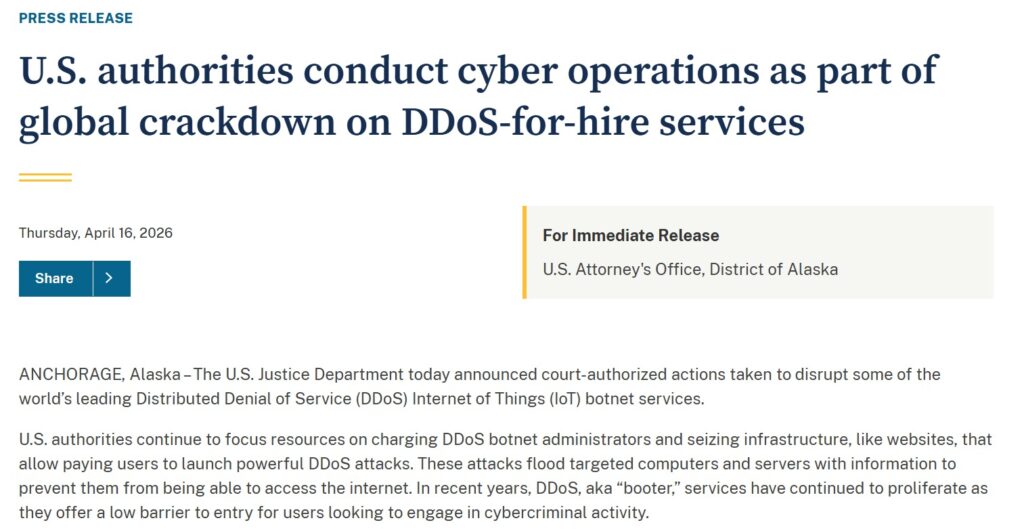
Worth noting the phrase here: these are described as IoT botnet services, meaning the traffic often comes from compromised smart devices, exactly the risk covered earlier in this guide.
⚠️ Old attacks aren’t off the hook: Recent Operation PowerOFF phases have specifically gone after customers, not just the people running the sites. Account data, payment records, and attack logs pulled from seized platforms give investigators a direct list of who used the service, even for attacks launched years earlier.
5. A Permanent Record That Follows You
Even outside a criminal conviction, being named in an investigation, receiving a formal warning letter, or having an ISP account terminated for abuse can surface in background checks, security clearance reviews, and university or employer investigations. For anyone considering a career in tech or cybersecurity specifically, this kind of record is disqualifying in a field where trust is the entire product.
Operation PowerOFF: The Ongoing Global Crackdown
The scale of this crackdown has grown sharply with each phase:
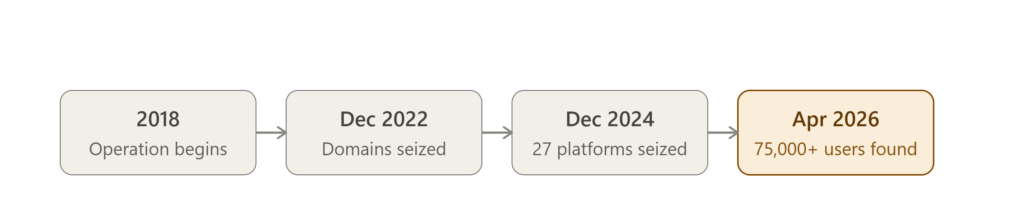
Notice the shift in the final phase. Earlier actions focused on seizing infrastructure. The most recent one focused on identifying the people who used it.
Operation PowerOFF isn’t a one-time sweep. It’s a sustained, multi-year international effort, and its most recent phase in 2026 marked a clear shift in strategy. Earlier phases focused on seizing infrastructure and arresting operators. The current phase is going after the customer base directly, using data recovered from seized platforms to identify tens of thousands of individual users.
Some of the seized platforms had operated for years and processed tens of millions of attacks, often for a cost as low as a few euros per attack. That low cost and low technical barrier is exactly why these services became so widespread, and exactly why they’ve become such a persistent law enforcement priority.
Europol’s own announcement of the operation makes the scale clear:
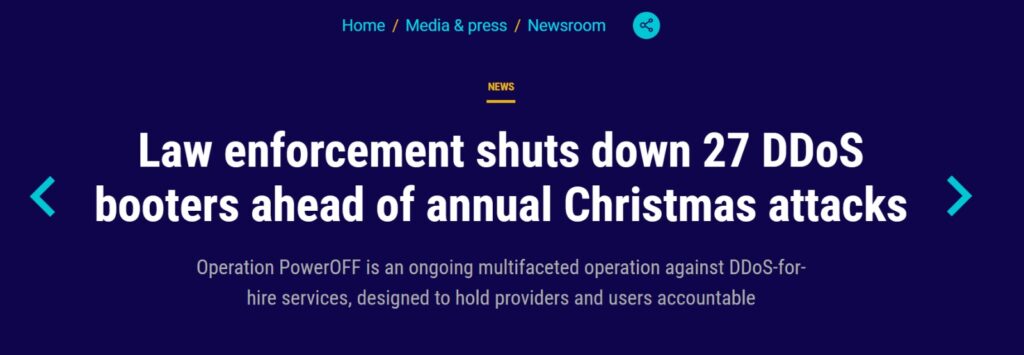
The subtitle here says it directly: this is designed to hold both providers and users accountable, not just the people running the sites.
Real-World DDoS Attacks That Made Headlines
Understanding the scale these attacks can reach helps explain why the legal consequences are taken seriously.
The 2016 Dyn DNS attack disrupted access to major platforms including Twitter, Netflix, and Reddit across large parts of the US by targeting core DNS infrastructure rather than a single website. The 2018 GitHub Memcached attack used a reflection technique to generate one of the largest traffic volumes ever recorded against a single target at the time. Cloudflare has since recorded and autonomously mitigated attacks that dwarf those historical peaks, including a 31.4 Tbps assault in late 2025.
Worth noting: not every major outage is a DDoS attack. Some, like the case we covered where an internet blackout was caused by a BGP failure, stem from routing mistakes rather than malicious traffic, but the practical impact on users looks similar either way.
Legal Ways to Stress Test Your Own Systems
If the actual goal is understanding how your own infrastructure holds up under load, legitimate open-source tools do exactly that without any legal exposure.
| Tool | Best For |
|---|---|
| Apache JMeter | General-purpose load testing, widely used and well documented |
| k6 | Developer-friendly scripting, integrates well with CI/CD pipelines |
| Locust | Python-based, good for simulating realistic user behavior at scale |
| Gatling | High-performance testing with detailed reporting |
| Vegeta | Lightweight command-line HTTP load testing |
| Artillery | Quick load and smoke testing for APIs and web services |
Every one of these tools does the same fundamental thing a stresser does, generate traffic and measure how a system responds, with one difference that matters entirely: you point it at infrastructure you own or have explicit written authorization to test. Layered defenses on the receiving end matter too, and the fundamentals in how firewalls protect networks apply directly here, with dedicated hardware like the FortiGate 100F handling meaningful traffic volume for organizations that need it.
✅ The cheapest fix is also the most effective one: Before reaching for any load testing tool, make sure it’s pointed only at systems you own or have signed authorization to test. This one habit is what keeps a security exercise a legal one.
Protecting Your Own Devices From Becoming Part of the Problem
Every device recruited into a botnet was someone’s router, camera, or smart device before it became an attacker’s tool. Two habits meaningfully reduce that risk on your own network: using a genuinely strong, unique password on anything with an internet-facing login, and never reusing that password across devices or accounts.
Our free password strength checker shows how long a given password would actually take to crack, and the passphrase generator creates long, memorable ones in seconds if you need a starting point. For anything protecting more than a single device, like an admin account, the practices in our login security checklist cover the rest of what a secure login actually requires.
If You’re Assessing Your Own Exposure
Organizations that depend on uptime, whether that’s an e-commerce site during a sales event or a school running exams online, benefit from thinking through this risk deliberately rather than reactively. Our threat model template gives you a structure for mapping which of your systems are realistic DDoS targets and what mitigation already exists. If an incident does happen, documenting it clearly matters for insurance, compliance, and simply learning from it, which is exactly what our security report template is built for.
Frequently Asked Questions
Can an IP stresser reveal my location?
Using one doesn’t reveal your location to you about anyone else. What it can do is expose your own IP address to the service you’re using, and increasingly, to the law enforcement agencies that have seized that service’s records.
What’s the worst someone can do with my IP address alone?
An IP address alone gives limited information, roughly your general geographic region and your ISP. It doesn’t hand over your name or home address directly. That said, it can be used to target your connection with a DDoS attack, and combined with other leaked information, it can contribute to a broader profile.
Should I be worried if someone has my IP address?
Mild caution is reasonable, extreme worry usually isn’t. An IP address by itself is not the same as your physical address, and ISPs don’t hand over subscriber information without a legal process. If you’re being targeted with attacks or harassment, your ISP and, if needed, law enforcement are the right people to involve.
What are the largest DDoS attacks in history?
Recent years have seen attacks measured well beyond a terabit of traffic per second, with Cloudflare recording a 31.4 Tbps attack in late 2025 alone. Attack sizes have grown consistently as more devices connect to the internet and larger botnets become available to rent.
Can I legally test my own server?
Yes. Testing infrastructure you own, or infrastructure you have documented written authorization to test, is legal and is standard practice in software development and security assessment.
Are free booter services safer than paid ones?
No, and in some ways they’re riskier. Free or cheap services tend to have weaker operational security, meaning their user logs and payment data are just as likely, if not more likely, to end up seized or leaked. Price has no bearing on the legality of using the service.
This article explains general legal risk and is not legal advice. Specific consequences depend on jurisdiction, intent, and the details of any individual case.
Conclusion
The direct answer to “is an IP stresser illegal” is yes, in nearly every real-world case, because the services are built around attacking systems you don’t own and haven’t been authorized to test. The gap between “legitimate stress testing” and a criminal act is authorization, nothing else.
Operation PowerOFF’s shift toward identifying individual users rather than just seizing sites means the old assumption that only service operators face consequences no longer holds. If the actual goal is testing how your own systems perform under load, the legitimate tools listed above do the job without any of the legal exposure.
This guide is part of our broader library of free security checklists, templates, and tools, all built to help you secure your own systems rather than attack someone else’s.

Abdul Shakoor writes practical, defensive cybersecurity and networking guides for SentrixHub. He focuses on making API security, mobile app security, authentication, and network concepts simple for beginners and developers.