
How scalable is DMVPN for large networks, and where exactly does it stop being the right answer? That second half of the question is the one most guides skip. DMVPN scales genuinely well, but it does not scale infinitely, and the point where it starts to strain is more predictable than most people expect.
Dynamic Multipoint VPN has been Cisco’s answer to flexible, secure WAN connectivity for well over a decade. It cuts configuration overhead and lets sites talk to each other dynamically. But as a network grows toward hundreds or thousands of nodes, real limits appear, and they appear in specific, well-documented places.
This is a research-based breakdown drawn from Cisco’s own design guidance rather than a field report. Where a number comes from Cisco documentation, it is linked so you can check it against your own platform.
📌 Worth knowing: In almost every large DMVPN design, the hub does not run out of raw bandwidth first. It runs out of the ability to maintain routing relationships with every spoke. That distinction shapes the entire scaling conversation.
What DMVPN Is and How It Works
DMVPN is a Cisco VPN architecture that lets many sites communicate securely over a hub-and-spoke design, without manually configuring a separate tunnel for every pair of sites.
Here is the shape of a DMVPN network. The solid lines are the permanent hub connections, and the dashed line is the temporary tunnel spokes build directly when they need to talk:
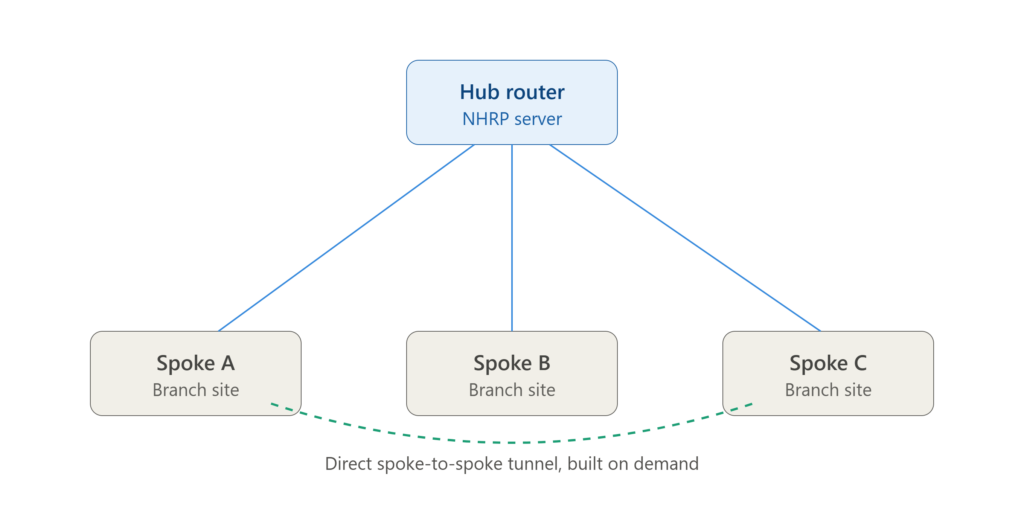
Every spoke keeps a permanent connection to the hub, but when two spokes need to talk directly, they build a temporary tunnel between themselves. That direct path is what keeps traffic off the hub and lets the design scale.
The core idea is simple. A central hub router acts as a coordination point. Spoke routers register with it dynamically. When two spokes need to talk directly, they can build a temporary spoke-to-spoke tunnel instead of routing everything through the hub. That on-demand direct tunneling is what separates DMVPN from a traditional static VPN, and it is the first reason it scales as well as it does.
What makes this work is a combination of three technologies rather than any single one. Understanding those three is the key to understanding the limits.
The Three Technologies Behind DMVPN
mGRE: the tunnel that does not need pre-configuration
Multipoint GRE lets a single tunnel interface on the hub serve every spoke at once. Without it, you would need a separate tunnel definition for each site, which is exactly the manual overhead DMVPN exists to avoid. mGRE also carries routing protocol traffic and multicast, which a plain IPsec tunnel cannot.
NHRP: the part that actually enables scale
Next Hop Resolution Protocol is the piece that makes dynamic connectivity possible, and it is the single most important component to understand. The hub maintains an NHRP database mapping each spoke’s tunnel address to its real public address. When a spoke boots, it registers with the hub. When it needs to reach another spoke directly, it queries the hub’s NHRP database for that spoke’s real address, then builds a direct tunnel.
This is elegant, and it is also where the hub’s workload concentrates. Every registration and every resolution request passes through one place.
This three-step exchange is the heart of how DMVPN stays dynamic. No tunnel to Spoke B exists until Spoke A actually needs it:
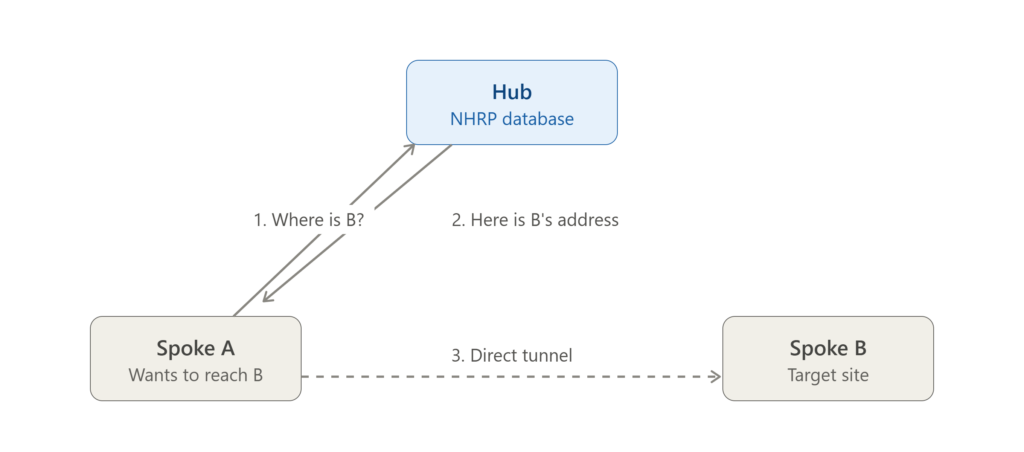
Notice that every resolution request passes through the hub. This is exactly why the hub, not bandwidth, becomes the scaling ceiling. The more spokes there are, the more registrations and lookups one router has to handle.
IPsec: the security layer
IPsec encrypts the GRE tunnels, providing confidentiality, authentication, and integrity. The final architecture is usually described as GRE over IPsec: GRE creates the flexible tunnel, IPsec secures it.
⚠️ Remember: The encryption and decryption work is real CPU load. Cisco’s own design guidance notes that when this process is not hardware-accelerated, total CPU utilization climbs and overall DMVPN throughput drops below what a plain IPsec design would deliver. If your hub is doing crypto in software, that ceiling arrives early.
If a visual walkthrough helps, this introduction from CCIE trainer Sikandar Shaik covers how DMVPN’s core pieces fit together:
The video lays out the same foundation covered above: how mGRE, NHRP, and IPsec combine to make dynamic, scalable tunnels possible. It is a useful primer before getting into the scaling limits.
So How Scalable Is DMVPN for Large Networks?
Here is the honest version, split into where it holds up and where it strains.
This is the single most important thing to understand about DMVPN scaling. Every spoke points back at the hub:
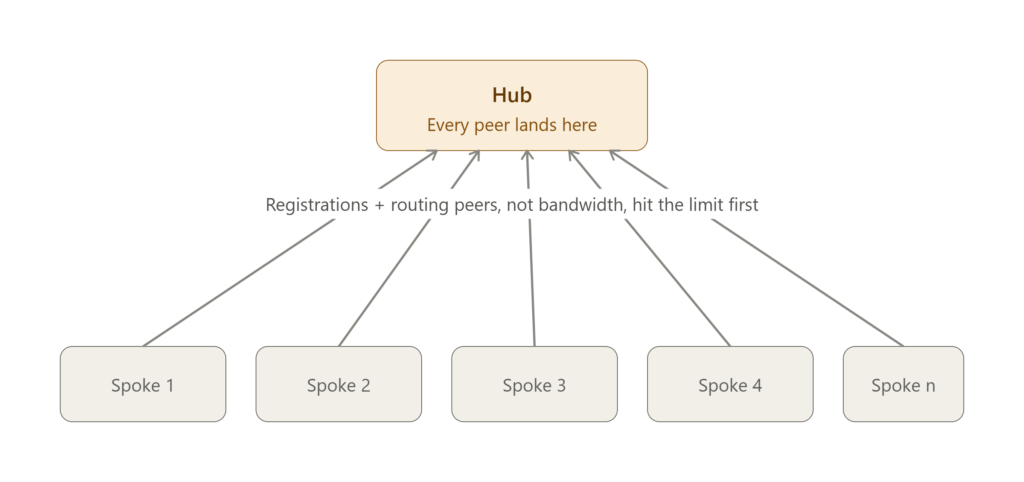
As spokes multiply, the hub’s real constraint is not how much traffic it can pass. It is how many routing relationships it can maintain at once. This is why large designs raise the peer ceiling with specific features and spread load across multiple hubs.
It scales well for hundreds of sites
For medium to large enterprise WANs, DMVPN is a proven, capable choice. Cisco positions it as a solution for building scalable enterprise VPNs supporting voice and video, and it comfortably supports large branch counts, adds new sites with near zero-touch configuration, and keeps the hub configuration static even as spokes multiply.
The hub is the ceiling, and it is a specific ceiling
Cisco’s design guidance is refreshingly direct about this: routing peers tend to be the limiting factor, not throughput. On older hub platforms, that limit fell somewhere around 500 to 700 routing peers, with up to 1000 proven on higher-end hardware in Cisco’s own scalability lab, as documented in the Cisco DMVPN design guide. The exact numbers have moved with newer platforms, but the shape of the limit has not.
This is the number that matters for planning, and it is why “how many spokes can I have” is really “how many routing peers can my hub sustain”.
Redundancy means running more than one hub
Because the hub is both the coordination point and a single point of failure, any serious deployment runs at least two. That solves the availability problem but multiplies the control-plane work, since spokes now register with and maintain routing relationships across multiple hubs. Redundancy at the hub is not optional at scale, but it is not free either.
Control plane load grows faster than you would like
As the network grows, NHRP tables expand, routing tables expand, and control plane traffic grows with them. The initial startup of a large DMVPN network is a known stress point, because IPsec tunnels, NHRP, and the routing protocol all establish at once. Cisco documents that under this load the routing protocol may fail to process inbound packets fast enough, causing spokes to time out and retransmit, which worsens the contention. Features like EIGRP Scale for DMVPN exist specifically to push the hub ceiling higher, up to 2500 sessions in that case.
Routing design becomes the hard part
At small scale, DMVPN routing mostly works itself out. At large scale, it becomes the most demanding part of the whole design. Route summarization, protocol choice, and split-horizon handling all become decisions with real consequences. One awkward detail worth knowing: in some phases and protocols, route summarization is not straightforward, which directly limits scalability unless worked around carefully. Get the routing design wrong and the network becomes unstable regardless of how powerful the hub hardware is.
Encryption load is easy to underestimate
Every tunnel is encrypted, and that IPsec processing is real CPU work on both the hub and the spokes. When crypto is handled in software rather than dedicated hardware, the CPU ceiling arrives well before the bandwidth ceiling does. Sizing a hub on throughput numbers alone, without accounting for encryption overhead, is a common way to under-provision it.
Spoke-to-spoke tunneling is what saves it
The feature that keeps DMVPN viable at scale is direct spoke-to-spoke communication. When spokes can talk directly, traffic stops funneling through the hub, latency drops, and hub load eases. This is the pressure-release valve, and it is why the later DMVPN phase that improves it matters so much.
Why DMVPN Phase 3 Matters
DMVPN has evolved through phases, and Phase 3 is the one that makes large deployments practical.
Earlier designs had a real constraint: spoke-to-spoke tunneling was limited, and summarization on the hub was difficult, which capped how large a single cloud could grow. Phase 3 changed the NHRP resolution process so that the hub can send redirects and spokes can build direct tunnels based on the actual traffic destination, while also allowing route summarization at the hub.
The practical result is better scaling, simpler spoke routing tables, and less permanent dependence on the hub for data traffic. For any large DMVPN network being designed today, Phase 3 is the baseline rather than an enhancement.
✅ Best practice: If you are designing or auditing a large DMVPN and it is not running Phase 3, that is the first thing to revisit. The summarization and dynamic spoke-to-spoke behavior it enables are precisely what large networks need, and retrofitting it later is more disruptive than starting with it.
IPsec VPN vs DMVPN
It helps to see where DMVPN sits relative to a plain IPsec VPN.
| Feature | IPsec VPN | DMVPN |
|---|---|---|
| Architecture | Point-to-point | Multipoint hub-and-spoke |
| Scaling | Limited, manual per tunnel | High, dynamic |
| Configuration | Manual for each link | Near zero-touch for new spokes |
| Routing protocol support | Limited | Full, over GRE |
| Spoke-to-spoke | Not native | Yes, on demand |
| Best fit | A handful of fixed sites | Large enterprise WAN |
The short version: a plain IPsec VPN is secure but rigid, and it does not scale without linear configuration effort. DMVPN adds the flexibility and dynamic routing that large networks need. The trade is added control-plane complexity concentrated at the hub.
Both, it is worth noting, are only as safe as the hardware they run on. An unpatched router terminating VPN tunnels is a serious exposure regardless of how well the tunnels themselves are designed, and understanding how CVE severity maps to real-world risk is part of keeping a VPN edge trustworthy. Older VPN endpoints running end-of-life code are a common weak point, the same pattern seen with aging platforms like the Cisco ISR 4451 at end of life, many of which are the exact units running DMVPN overlays today.
Where DMVPN Fits, and Where It No Longer Does
Still a strong fit
Structured enterprise WANs with a known, relatively stable set of physical branch sites. Retail chains, bank branch networks, and telecom backhaul all fit this shape well.
Environments already invested in Cisco routing where the operational expertise and hardware are in place.
Networks that benefit from dynamic spoke-to-spoke traffic without wanting a full commercial SD-WAN commitment.
A weaker fit
Cloud-first architectures. DMVPN was designed for physical routers connecting physical sites. It does not map cleanly onto cloud-native environments where workloads are dynamic and there is no router to anchor a spoke.
Networks moving toward SASE or SD-WAN. The industry has been shifting this direction, and by 2026 the architectural successors to DMVPN are increasingly SD-WAN overlays and mesh VPN approaches. These handle cloud integration, centralized policy, and application-aware routing in ways DMVPN was never built for.
Very large, rapidly changing topologies where the hub routing-peer ceiling becomes a hard constraint faster than the business can tolerate.
A Realistic Setup Overview
For anyone newer to DMVPN, the build order looks roughly like this. It is a map of the moving parts rather than a full configuration walkthrough.
On the hub: configure the mGRE tunnel interface, set up NHRP as the server, apply IPsec protection, and enable the routing protocol. On each spoke: configure the tunnel interface, point NHRP at the hub, apply matching IPsec, and join the routing protocol.
The core components stay consistent across any deployment: a hub router, spoke routers, NHRP doing the address resolution, mGRE providing the tunnels, and IPsec securing them. Everything else is tuning.
High availability is usually layered on top through multiple hubs, since a single hub is both the coordination point and a single point of failure. Redundancy at the routing and hardware level matters here, and the principles in stateful switchover apply directly to keeping a hub-and-spoke overlay online through a failover.
Frequently Asked Questions
How scalable is DMVPN for large networks?
Highly scalable for structured enterprise WANs with hundreds of sites, but not unlimited. The practical ceiling is the hub’s ability to maintain routing adjacencies with every spoke, not raw bandwidth. Cisco’s own guidance identifies routing peers as the limiting factor.
Which protocol maps logical tunnel IPs to real physical IPs in DMVPN?
NHRP, the Next Hop Resolution Protocol. The hub keeps an NHRP database of each spoke’s real public address and resolves it on request so spokes can build direct tunnels.
What encapsulation does DMVPN use?
GRE over IPsec. Multipoint GRE creates the flexible tunnel that carries routing and multicast traffic, and IPsec encrypts it for security.
What are the benefits of DMVPN Phase 3?
Phase 3 enables dynamic spoke-to-spoke tunnels based on traffic destination and allows route summarization at the hub. That means better scaling, simpler spoke routing tables, and less dependence on the hub for data traffic.
What is the main limitation of DMVPN at scale?
The hub. All NHRP registrations and routing relationships concentrate there, so control-plane load, not throughput, is what caps the design. This is why large deployments use multiple hubs and features that raise the routing-peer ceiling.
Is DMVPN still worth using in 2026?
For established Cisco-based enterprise WANs with physical branch sites, yes. For cloud-first or greenfield builds, SD-WAN and mesh VPN approaches are increasingly the better architectural fit.
Conclusion
So, how scalable is DMVPN for large networks? Genuinely scalable, within limits that are well understood and well documented.
It handles hundreds of structured branch sites reliably, and Phase 3 with a sound routing design pushes that further. The ceiling is the hub’s control plane rather than its bandwidth, which is why large designs lean on multiple hubs and careful routing choices. Where it struggles is the cloud-first, rapidly changing environment, and that is exactly the space SD-WAN and mesh VPNs have moved into.
For a network engineer, the useful takeaway is not “DMVPN is scalable” or “DMVPN is outdated”. It is knowing which shape of network you have. A stable, router-anchored enterprise WAN is still a good home for DMVPN. A cloud-native or fast-shifting one has probably already outgrown it.

Abdul Shakoor writes practical, defensive cybersecurity and networking guides for SentrixHub. He focuses on making API security, mobile app security, authentication, and network concepts simple for beginners and developers.