
In modern enterprise networks, downtime is not acceptable. Even a few seconds of disruption can impact business operations, user experience, and critical applications. This is where Stateful Switchover becomes essential. It is a high availability technology that allows network devices to fail over instantly without interrupting active sessions.
In many enterprise environments, Stateful Switchover behavior is rarely noticed during normal operation because redundancy mechanisms remain idle until an unexpected supervisor or route processor failure occurs.
In some enterprise environments, failover weaknesses remain unnoticed for months until a maintenance window or unexpected hardware instability exposes hidden synchronization or redundancy problems.
Unlike traditional failover methods, Stateful Switchover ensures that ongoing connections, routing information, and session states are preserved during a failure. This makes it a core feature in Cisco HA (High Availability) environments and a reliable enterprise network failover solution.
As networks grow more complex, the need for uninterrupted network failover continues to increase. Technologies like Stateful Switchover help organizations maintain continuous service, improve reliability, and reduce downtime risks.
For deeper understanding of enterprise redundancy and recovery behavior, you can also explore
Enterprise Failover Stability Alternate Ports
To better understand network resilience concepts, you can also explore how infrastructure failures impact connectivity in
👉 Internet Blackout Due to BGP Failure
What is Stateful Switchover?
Stateful Switchover (SSO) is a redundancy feature that allows a standby device or processor to take over immediately when the active device fails, without losing session information.
In simple terms, both active and standby systems maintain the same state data, including:
- Routing tables
- Session information
- Interface status
- Protocol states
Because of this synchronization, failover happens seamlessly.
In production environments, fast recovery is especially important because even short interruptions may affect VoIP calls, wireless authentication sessions, and cloud application connectivity.
This makes Stateful Switchover a powerful solution for environments where continuous connectivity is critical.
How Stateful Switchover Maintains Network Availability
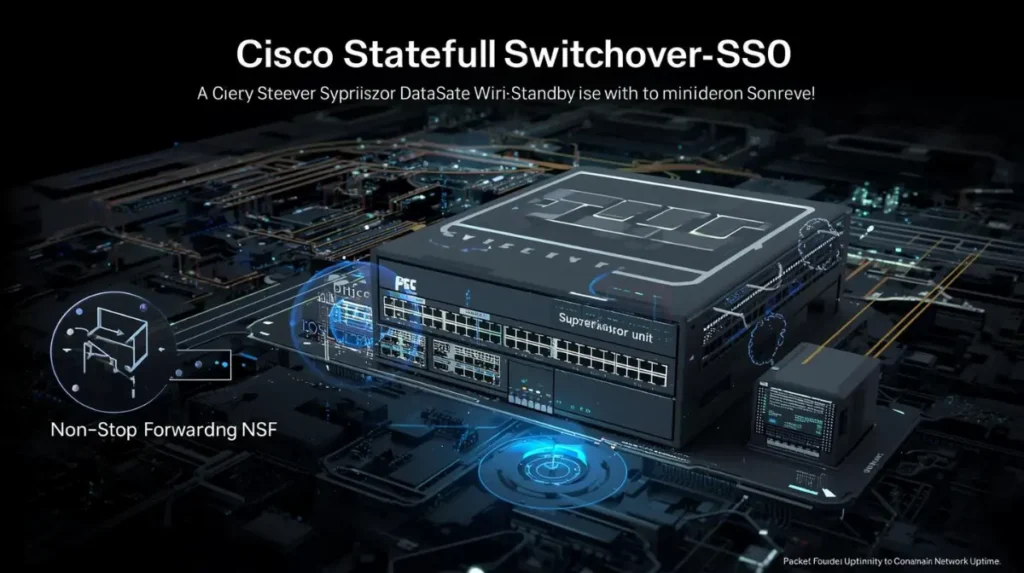
Active and standby processors continuously synchronize state information to ensure rapid failover during hardware or control plane failures.
How Stateful Switchover Works in Cisco Systems
In Cisco environments, Stateful Switchover is implemented using dual supervisors or routing processors.
Here’s how it works:
- Active and Standby Setup
Two processors are configured—one active and one standby. - Continuous Synchronization
The active processor continuously updates the standby with real-time data. - Failure Detection
If the active processor fails, the system detects it instantly. - Immediate Switchover
The standby processor takes control without resetting sessions. - Traffic Continuity
Data forwarding continues, ensuring uninterrupted network failover.
During production failovers, engineers often monitor routing stability, adjacency recovery, and packet forwarding behavior carefully because some enterprise applications may temporarily experience latency spikes even when traffic forwarding remains operational.
This mechanism is often combined with Non-Stop Forwarding (NSF) to maintain packet flow during control plane failures.
Rapid failover and convergence improvements are also closely related to modern Layer 2 recovery mechanisms explained in Serious STP Failures That RSTP Prevents
Without proper NSF support, routing reconvergence delays after a switchover may temporarily affect VoIP traffic, authentication services, and cloud application responsiveness in enterprise environments.
For deeper Cisco SSO technical understanding:
https://ipcisco.com/lesson/cisco-stateful-switchover-sso/
The following demonstration explains how Stateful Switchover maintains network availability by synchronizing redundancy information between active and standby processors during failover events.
Enterprise engineers often combine SSO with NSF to reduce traffic interruption during route processor failures and maintain forwarding continuity during recovery operations.
Stateful vs Stateless Failover Comparison
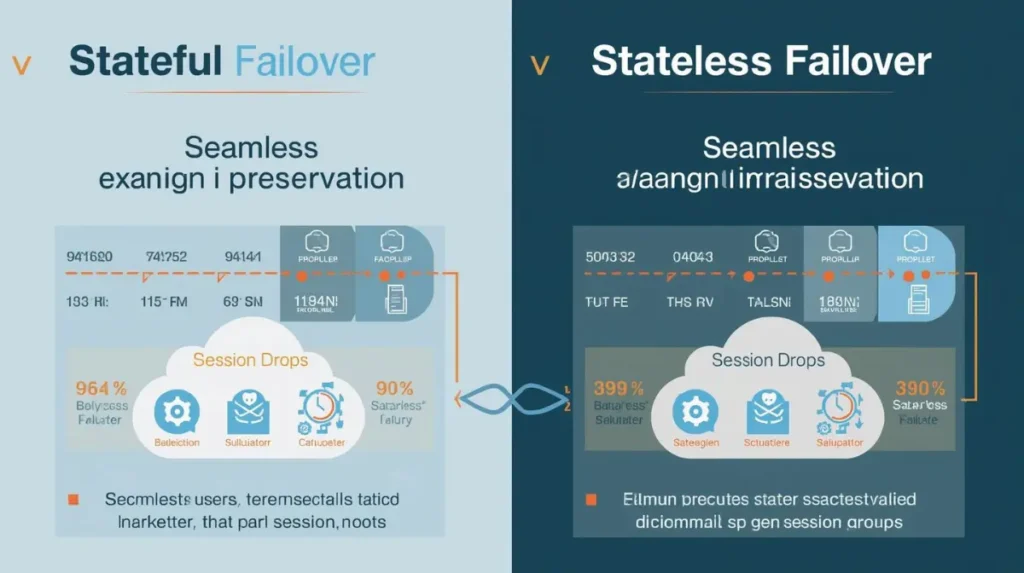
Stateful failover preserves session information during switchover events, while stateless failover typically resets active connections.
Stateful vs Stateless Failover
Understanding stateful vs stateless failover is important when designing high availability systems.
Stateful Failover
- Maintains session data
- No connection drops
- Seamless transition
- Ideal for enterprise networks
Stateless Failover
- Does not preserve sessions
- Connections reset during failover
- Users must reconnect
- Less reliable for critical systems
Because of these differences, Stateful Switchover is preferred in enterprise environments.
Benefits of Stateful Switchover
Stateful Switchover provides several key advantages:
Many enterprise failover environments also depend heavily on stable topology behavior and proper recovery planning discussed in Enterprise STP Problems and Troubleshooting Methods
Why Fast Enterprise Failover Matters

Even short failover interruptions may affect VoIP communication, authentication systems, and cloud application performance in enterprise environments.
1. Near-Zero Downtime
Active sessions continue without interruption.
2. Improved User Experience
Users don’t notice failover events.
In reality, experienced engineers know that some sensitive enterprise services may still experience brief instability during failover events, especially in environments with routing convergence delays or partially synchronized standby systems.
3. High Reliability
Ensures continuous service availability.
4. Business Continuity
Supports critical applications like VoIP and financial systems.
5. Reduced Packet Loss
Maintains traffic flow during failures.
These benefits make Stateful Switchover a key part of any enterprise network failover solution.
To understand how network protection mechanisms work alongside redundancy, read:
👉 How Firewalls Protect Networks From Cyber Attacks
Enterprise High Availability and Redundancy Design
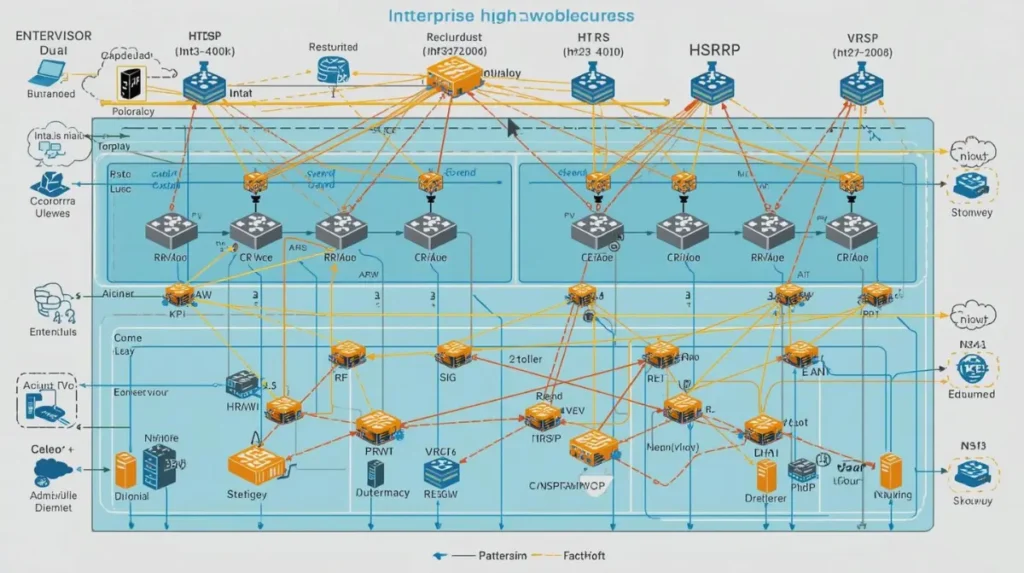
Modern enterprise infrastructures combine multiple redundancy technologies to minimize downtime during failures.
Cisco HA (High Availability) and Redundancy Concepts
Cisco HA solutions combine multiple redundancy technologies.
Key Components:
- Hardware Redundancy
- Dual supervisors
- Backup power supplies
- Control Plane Redundancy
- Stateful Switchover
- Protocol synchronization
- Data Plane Continuity
- Non-Stop Forwarding (NSF)
- Network Redundancy
- HSRP / VRRP
- Load balancing
In some enterprise deployments, misconfigured alternate paths or incomplete redundancy planning create situations where failover technically succeeds while traffic performance remains unstable during recovery periods.
Network engineers frequently validate heartbeat communication, standby synchronization, and redundancy health before scheduled maintenance because hidden failover weaknesses may remain undetected during normal operation
Together, these features ensure continuous operation even during failures.
For more insights into enterprise network hardware:
👉 FortiGate 100F Firewall
Real-World Use Cases and Examples
Stateful Switchover is widely used across industries.
1. Financial Sector
Banks use SSO to prevent transaction interruptions.
2. Data Centers
Ensures continuous application and server access.
3. Telecom Providers
Maintains voice and data services without disruption.
4. Enterprise IT Systems
Supports internal applications and cloud services.
In large enterprise environments, failover events sometimes reveal hidden configuration inconsistencies between active and standby systems that were never detected during routine operation.
Real Enterprise Failover Recovery Scenario

Stateful Switchover enables standby processors to take over rapidly during critical infrastructure failures.
Example Scenario:
A core switch fails in a data center. With Stateful Switchover:
- Standby processor takes over instantly
- No session drops occur
- Applications continue running
During real failover incidents, engineers often verify whether all VLANs, routing adjacencies, and upstream paths recovered consistently because certain traffic segments may stabilize slower than others after switchover events.
This ensures uninterrupted network failover.
To understand how application-level analysis works in networks, explore:
👉 Charles Proxy Mac Setup
Routing Processor Redundancy Explained
Routing Processor Redundancy (RPR) is another high availability method.
RPR vs Stateful Switchover
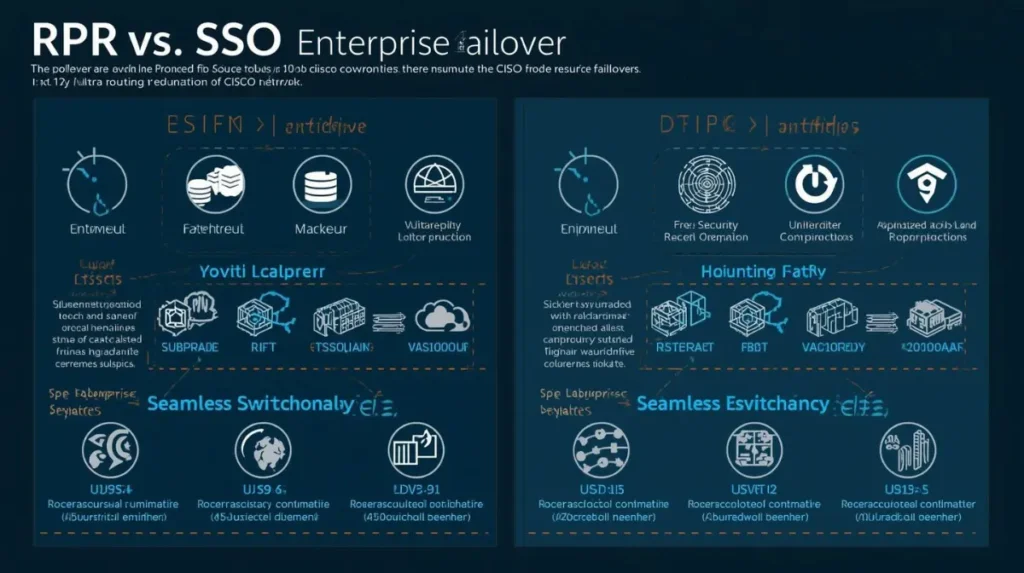
Stateful Switchover provides significantly faster and more reliable failover behavior compared to traditional routing processor redundancy methods.
RPR vs SSO:
- RPR
- Slower failover
- No session preservation
- Standby initializes after failure
- SSO
- Instant failover
- Sessions preserved
- Standby always ready
Many enterprise teams prefer Stateful Switchover because traditional failover methods may introduce recovery delays that become noticeable during VoIP communication, cloud application access, or firewall session synchronization.
Because of this, Stateful Switchover is a more advanced and efficient solution.
For additional technical insight:
https://study-ccnp.com/understanding-sso-cisco-stateful-switchover/
The Future of Enterprise Network Resilience

Modern enterprise infrastructures increasingly rely on intelligent failover and redundancy systems to maintain continuous service availability.
Conclusion
Stateful Switchover is a critical technology for modern network reliability. It ensures that even during hardware or system failures, network operations continue without disruption.
By preserving session data and enabling seamless transitions, it provides true uninterrupted network failover. This makes it an essential part of Cisco HA (High Availability) and any robust enterprise network failover solution.
As enterprise infrastructures become increasingly dependent on uninterrupted connectivity, network engineers continue prioritizing resilient failover architecture, standby synchronization reliability, and rapid recovery behavior to reduce operational risk during unexpected failures.
As networks continue to evolve, implementing Stateful Switchover will remain a key strategy for achieving high performance, resilience, and business continuity.
FAQs
1. What is Stateful Switchover?
Stateful Switchover is a high availability feature that allows seamless failover without losing session data.
2. What is the difference between stateful vs stateless failover?
Stateful failover preserves sessions, while stateless failover drops connections during failure.
3. Does Stateful Switchover cause downtime?
It provides near-zero downtime, ensuring uninterrupted operations.
4. Where is Stateful Switchover used?
It is used in data centers, enterprise networks, telecom systems, and financial institutions.
5. How does Cisco HA use Stateful Switchover?
Cisco HA uses SSO with redundant processors to ensure continuous network availability.
6. Why is Stateful Switchover important?
It ensures reliability, performance, and uninterrupted network failover in critical systems.
Related Enterprise Networking Articles
Enterprise Failover Stability and the Role of Alternate Ports
Serious STP Failures That RSTP Prevents
Enterprise STP Problems and Troubleshooting Methods
Dangerous STP Timer Mistakes Beginners Make

Abdul Shakoor writes practical, defensive cybersecurity and networking guides for SentrixHub. He focuses on making API security, mobile app security, authentication, and network concepts simple for beginners and developers.