
By Abdul Shakoor
Most cybersecurity conversations today revolve around ransomware, API abuse, and zero-days. So it’s easy to wave away an attack that first appeared decades ago as a museum piece. But the Fraggle attack is worth your attention precisely because it’s old — its core mechanics (spoofing, amplification, and abusing trust in network packets) are the same mechanics driving some of the largest DDoS campaigns happening right now.
In other words, understanding Fraggle isn’t a history lesson. It’s a way of seeing a pattern that keeps repeating: small input, massive output, system down. Once you recognise that pattern, a whole family of modern attacks — DNS amplification, NTP amplification, memcached floods — suddenly makes sense. Let me walk through what a Fraggle attack is, exactly how it works, and why the lesson behind it still matters for anyone defending networks, APIs, or mobile backends.
What a Fraggle attack actually is
A Fraggle attack is a type of Distributed Denial-of-Service (DDoS) attack that abuses UDP traffic and network broadcast behaviour to overwhelm a target.
Put plainly: the attacker sends spoofed UDP packets to a network’s broadcast address, tricking many devices into replying all at once — and all those replies are aimed at the victim. The victim drowns under a flood of responses it never asked for.
What makes it clever (and cheap) is that the attacker doesn’t need a huge botnet or powerful infrastructure. It leans on two almost-forgotten services — the UDP Echo service on port 7 and the Chargen service on port 19 — combined with the way IP broadcast works. A small push from the attacker becomes a huge wave aimed at the target. That “leverage” is the whole point, and it’s why amplification attacks remain so attractive to this day.
📌 The key idea: A Fraggle attack is all about leverage. The attacker sends a small amount of traffic, but by bouncing it off a whole network of devices, the victim gets hit with a flood many times larger. Small input, massive output — that’s the entire trick.
How a Fraggle attack works, step by step
The mechanics are simple, which is part of what makes them enduring.
It starts with a spoofed source IP. The attacker crafts UDP packets but forges the source address so the packets appear to come from the victim. This IP spoofing is the foundation — without it, the replies would go back to the attacker instead of the target.
Those packets go to a broadcast address. Rather than hitting one machine, the attacker sends them to a network broadcast address (something like 192.168.1.255), so every device on that segment receives a copy.
Vulnerable UDP services respond. Devices running Echo (port 7) dutifully reply with the same message; devices running Chargen (port 19) reply with a stream of characters. Neither service checks whether the request was genuine — UDP is connectionless, so there’s no handshake and no validation.
Amplification kicks in. Every responding device sends its reply to the spoofed source — the victim. One attacker packet becomes dozens or hundreds of responses.
The victim is overwhelmed. Flooded with replies from many devices at once, the target suffers bandwidth exhaustion, slowdowns, and eventually an outage. The service goes dark, which was the goal all along.
Watch: How Amplification Attacks Work
If you’d rather see the amplification effect than read about it, the video above walks through how spoofing and broadcast traffic combine to flood a target. Even if it focuses on Smurf or general DDoS amplification, the mechanics are the same as Fraggle — only the protocol differs.
Where it sits: DDoS in plain terms
To place Fraggle in context: a DDoS attack is simply when many systems flood a target with traffic until it can no longer serve legitimate users. DDoS attacks generally fall into four buckets — volumetric (raw bandwidth exhaustion), protocol attacks (like SYN floods), application-layer attacks (like HTTP floods), and amplification attacks. Fraggle belongs squarely in that last category, alongside its more famous cousin, the Smurf attack.
Fraggle vs Smurf: the key difference
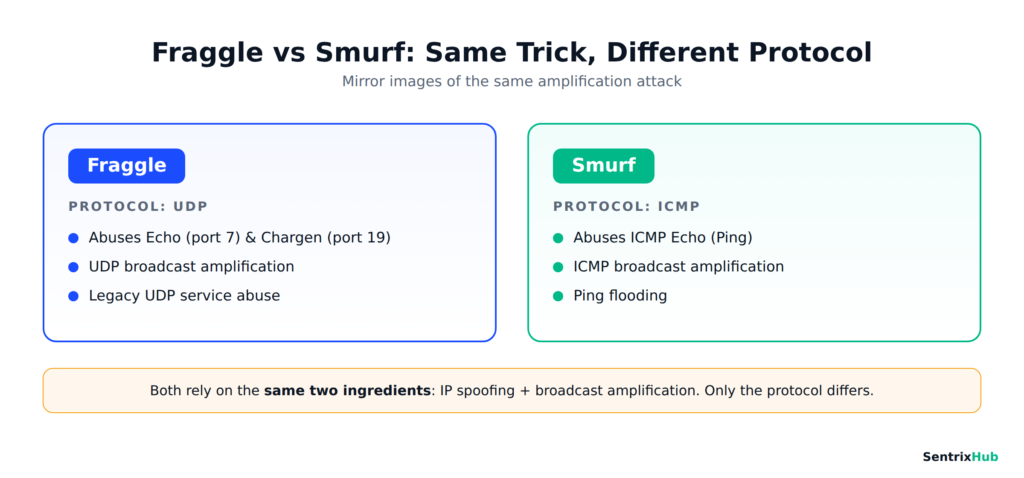
These two are almost always mentioned together because they’re structurally identical twins — the only real difference is the protocol they abuse.
| Feature | Fraggle Attack | Smurf Attack |
|---|---|---|
| Protocol | UDP | ICMP |
| Target service | Echo / Chargen | ICMP Echo (Ping) |
| Amplification via | UDP broadcast | ICMP broadcast |
| Classic use | Legacy UDP abuse | ICMP flooding |
📌 Easy way to remember: Smurf uses ping (ICMP); Fraggle uses UDP services (Echo and Chargen). Everything else — the spoofing, the broadcast, the amplification — is identical. Learn one and you understand both.
The simplest way to remember it: Smurf uses ping (ICMP); Fraggle uses UDP services. Both rely on the same two ingredients — IP spoofing and broadcast amplification. Learn one and you essentially understand the other.
The OSI layers involved
For those who like to place things precisely, a Fraggle attack primarily operates at Layer 3 (Network), since it exploits how packets are routed to broadcast addresses, while also interacting with Layer 4 (Transport) because it abuses UDP services. The reason UDP is so attractive here comes back to one property: it’s connectionless. There’s no handshake to complete and no session to validate, so a spoofed packet is accepted and answered without question. That lack of verification is the soft spot the whole attack depends on.
⚠️ Why UDP is the weak spot: UDP is connectionless — there’s no handshake and no validation of who sent a packet. That means a spoofed request is accepted and answered without question. This lack of verification is exactly what the whole attack depends on.
Why a “dead” attack still matters
You’d be forgiven for assuming this is obsolete. Modern networks have largely closed the specific holes Fraggle used — but “largely” is doing a lot of work in that sentence. Misconfigured routers still exist. Legacy services are still switched on in forgotten corners. IoT devices ship with weak defaults and rarely get hardened.
More importantly, the technique never died — it evolved. Today’s attackers use the exact same amplification logic in DNS amplification, NTP amplification, and memcached attacks, some of which have produced record-breaking DDoS volumes. Fraggle is the simple ancestor that teaches the principle every one of those modern attacks relies on. This is the same discipline behind solid firewall and network protection — you defend against the pattern, not just the specific tool.
The connection to API security
At first glance, a UDP broadcast attack seems worlds away from APIs. But the underlying idea maps directly. An API can be abused for amplification too: if an attacker can send a small request that triggers a large or expensive response, they’ve recreated the Fraggle pattern at the application layer. Send a little, cause a lot.
That’s exactly why good API and firewall security leans so heavily on rate limiting, input validation, and abuse detection — and why runtime defences like a RASP tool matter for catching abusive patterns as they happen. The protocol changes; the defensive mindset doesn’t.
The connection to mobile app security
Mobile apps lean heavily on backend APIs, which makes them another route to the same problem. If an attacker compromises the client side — using an instrumentation tool like Frida to automate and manipulate requests — they can hammer backend services and trigger amplification from the app layer. The transport is different from classic Fraggle (HTTPS rather than UDP Echo), but the amplification mindset is identical: automate small requests, provoke large effects.
A realistic scenario
Picture a company running some legacy network gear, with UDP services still enabled and loose firewall rules. An attacker spoofs a victim’s IP, fires UDP packets at the network’s broadcast addresses, and triggers a wave of responses from every device that answers. Within seconds, the victim’s network is saturated and services fall over. No exotic malware, no zero-day — just old services and weak configuration doing exactly what they were (accidentally) left able to do. This kind of network-level outage is a cousin of the disruption seen in events like a major BGP failure: the internet’s plumbing, misused or misconfigured, taking services offline.
The mistakes that keep Fraggle alive
Every one of these is avoidable, which is what makes them frustrating.
Leaving UDP Echo and Chargen enabled — these services have almost no legitimate use today and should simply be off. Allowing directed broadcast traffic — routers should not forward directed broadcasts, full stop. No ingress filtering — failing to drop packets with obviously spoofed source addresses is a foundational miss. Weak firewall rules that wave through suspicious UDP traffic on unknown ports. And ignoring legacy systems, which quietly keep vulnerable services alive long after everyone forgot they existed.
How to stop a Fraggle attack
The defences are refreshingly concrete:
Disable unnecessary UDP services — turn off Echo (port 7) and Chargen (port 19). Block broadcast traffic by disabling IP-directed broadcasts on your routers, which single-handedly kills the classic Fraggle vector. Implement ingress filtering so only packets with valid source addresses are allowed in, defeating the spoofing the attack depends on. Configure firewalls properly to drop suspicious UDP and unknown ports — the same hardening that a well-run appliance like a FortiGate firewall is built to enforce. Segment your network to limit how far broadcast traffic can spread internally. And apply rate limiting to cap how many responses can be generated.
✅ The single biggest win: Disable IP-directed broadcasts on your routers. This one change kills the classic Fraggle vector on its own. Pair it with turning off Echo (port 7) and Chargen (port 19), and add ingress filtering to defeat spoofing — and the attack simply has nowhere to land.
A few sharper insights
After looking at enough of these, some higher-level lessons stand out.
Monitor behaviour, not just bandwidth — combine network and application monitoring, because a small request triggering a large response is a red flag no matter which layer it happens on. Watch for those amplification patterns specifically. Apply zero-trust thinking to internal traffic and legacy devices rather than assuming “inside” means “safe” — the same lesson that shows up in how attackers exploit enterprise Wi-Fi from positions people assumed were trusted. And genuinely learn from old attacks: Fraggle, Smurf, and LAND all teach the same core truth — never trust the origin of a packet.
The bottom line
The Fraggle attack doesn’t make headlines anymore, but its DNA is everywhere. It teaches, in the simplest possible form, how amplification works, why spoofing is dangerous, and how weak configuration turns into major outages. From network infrastructure to APIs to mobile backends, the same shape keeps reappearing:
Small input → massive output → system failure.
Defend against that pattern — through filtering, hardening, rate limiting, and behavioural monitoring — and you’re already ahead of a huge range of threats, old and new alike. That’s the real value of studying a “forgotten” attack: it hands you the principle for free.
Frequently asked questions
What is a Fraggle attack?
A Fraggle attack is a UDP-based DDoS attack that uses broadcast amplification — sending spoofed UDP packets to a broadcast address so many devices flood the victim with replies.
What’s the difference between a Smurf attack and a Fraggle attack?
They’re structurally identical; only the protocol differs. Smurf abuses ICMP (ping), while Fraggle abuses UDP services like Echo and Chargen.
What OSI layer does a Fraggle attack target?
Mainly Layer 3 (Network), where broadcast routing is exploited, with interaction at Layer 4 (Transport) through the abused UDP services.
Can Fraggle attacks still happen today?
Yes, in misconfigured or legacy networks. Modern hardening has reduced the risk sharply, but the underlying amplification technique lives on in DNS, NTP, and memcached attacks.
How do you stop a Fraggle attack?
Disable UDP Echo and Chargen, block IP-directed broadcasts, implement ingress filtering against spoofed IPs, configure firewalls to drop suspicious UDP, segment the network, and apply rate limiting.
For more on network and application defence, explore our guides on how firewalls protect networks, the FortiGate 100F firewall, and API and firewall security.

Abdul Shakoor writes practical, defensive cybersecurity and networking guides for SentrixHub. He focuses on making API security, mobile app security, authentication, and network concepts simple for beginners and developers.