
By Abdul Shakoor
At first glance, CVE-2025-58754 looks like a routine denial-of-service bug in a popular JavaScript library. Look closer, though, and you’ll find a near-perfect storm: a massively adopted dependency, a zero-barrier attack path, and the kind of silent misconfiguration that many teams don’t discover until production goes dark.
This is one of those vulnerabilities that’s trivial to fix and surprisingly easy to overlook — which is exactly the combination that gets services taken offline. Here’s the full picture: what it is, how an attack works, how to detect it, and how to shut it down.
What is CVE-2025-58754?
CVE-2025-58754 is a Denial of Service (DoS) vulnerability in Axios, the widely-used promise-based HTTP client for Node.js and browsers. Published on September 12, 2025, it carries a CVSS v3.1 base score of 7.5 (High) from the National Vulnerability Database (NVD).
The flaw lives in how Axios handles data: scheme URLs on Node.js. Instead of making an actual HTTP request — which would be subject to size enforcement — Axios decodes the entire payload directly into memory as a Buffer or Blob, bypassing the maxContentLength and maxBodyLength limits entirely. An attacker who can supply a large data: URI crashes the Node.js process.
| Field | Detail |
|---|---|
| CVE ID | CVE-2025-58754 |
| Affected Library | Axios (npm) |
| Affected Versions | 0.28.0 – 0.30.1 and 1.x – 1.11.x |
| Patched Versions | 0.30.2 and 1.12.0 |
| CVSS Score | 7.5 (High) |
| CWE | CWE-770: Allocation of Resources Without Limits or Throttling |
| Attack Vector | Network — no auth, no user interaction required |
| Impact | Availability only (DoS / OOM crash) |
📌 Why this one matters: Why this one matters: The dangerous combination here is high adoption plus zero authentication. Axios is in millions of projects, and this attack needs no login, no user interaction, and no special skill — just one oversized request to an exposed endpoint.
Technical Overview
When Axios gets a standard https:// URL on Node.js, it performs a real HTTP request and enforces your configured size limits. When it gets a data: URL, something different happens — the Node adapter calls an internal helper, from Data URI(), which decodes the Base64 payload directly into memory.
The problem: fromDataURI() in vulnerable versions never consults maxContentLength or maxBodyLength. Those guards only apply to the HTTP response path. The data: code path is completely unguarded.
The affected code sits in lib/adapters/http.js. The fix in versions 0.30.2 and 1.12.0 introduces estimateDataURLDecodedBytes(), which checks the payload size against configured limits before allocating memory. Notably, the bug also affects requests using responseType: 'stream' — developers who assumed stream mode would prevent full buffering were wrong here.
How an Attack Could Work
How the Attack Unfolds: From Recon to Crash
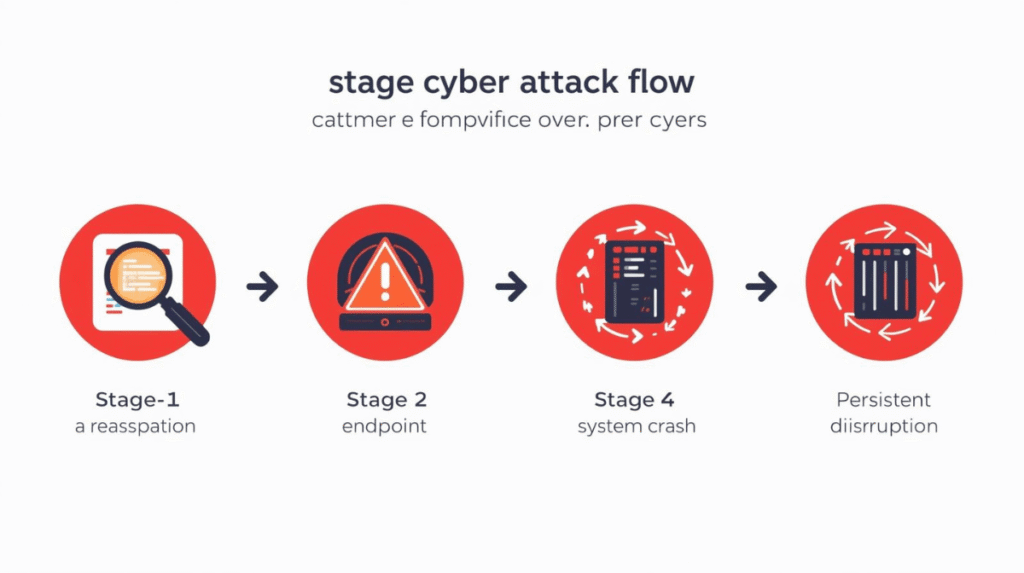
The attack moves through four stages — identifying that a target uses Axios, finding an endpoint that accepts user URLs, sending an oversized data: URI, and repeating it to keep the service down. Each step takes surprisingly little effort.
The attack unfolds in four stages, and what’s striking is how little effort each one takes.
Stage 1 — Reconnaissance.
The attacker confirms the target uses Axios. This is surprisingly easy: package lock files in public GitHub repos, stack traces in error responses, or framework-specific HTTP headers all give it away.
Stage 2 — Finding the attack surface.
The attacker looks for any endpoint where user-supplied input reaches an Axios call — link preview generators, webhook resolvers, media fetchers, proxy endpoints. If the application passes a user-provided URL to axios.get() without scheme validation, the path is open.
Stage 3 — Triggering the crash.
The attacker submits a data: URI with a massive Base64 payload — hundreds of megabytes or more. Axios calls from Data URI(), Node.js tries to allocate the memory in one synchronous operation, the heap fills, and the process crashes.
Stage 4 — Persistent disruption.
Because no authentication is required, the attack is repeatable. In auto-scaling environments, this can also generate significant unexpected compute costs as infrastructure cycles through crash-restart loops.
⚠️ The real risk: This isn’t a one-time crash. A zero-auth, repeatable crash path means an attacker can keep a service down for as long as they like — and in auto-scaling setups, run up your cloud bill while doing it.
Exploitation status
CISA’s advisory classification marks this with exploitation status “PoC” — a public proof-of-concept exists. That matters because PoC availability shortens the gap between disclosure and real-world exploitation attempts. Attackers don’t need to reverse-engineer anything.
The attack is constrained to DoS only — no data exfiltration, no remote code execution. But a persistent, zero-authentication crash path against a production service is a serious operational risk regardless. The low attack complexity combined with no privileges required makes this straightforward for any attacker who can reach an exposed endpoint.
Open source ecosystem impact
The GitHub Security Advisory (GHSA-4hjh-wcwx-xvwj) was published September 11, 2025. Teams with Depend a bot enabled received automatic alerts. Teams without active dependency scanning had no automated signal — their exposure window depended entirely on manual processes.
Snyk, npm audit, and GitHub Dependabot all detect CVE-2025-58754 for any project on an affected Axios version. The important nuance: SCA tools flag the vulnerability regardless of whether your application actually accepts user-supplied URLs. A Snyk alert here warrants investigation to understand your specific attack surface, not just a reflexive update click.
Axios is also commonly pulled in as a transitive dependency — meaning you may be exposed through a third-party package that wraps Axios internally. npm ls axios (not npm list) shows the full dependency tree, including indirect references.
⚠️ Don’t skip this: Even if your code never calls Axios directly, a package you depend on might. Always check the full tree with npm ls axios — transitive dependencies are where “we’re not affected” turns into “we were affected the whole time.”
Business Impact
For security teams that need to communicate risk upward, here’s how this translates beyond the code.
Operational:
A crash-loop in one Node.js microservice can propagate failures to dependent services through timeout chains. In API-heavy architectures, a single vulnerable endpoint can be leveraged to destabilize a broader system.
Financial:
Downtime costs money — SLA penalties, support overhead, revenue loss during outages, and unexpected cloud compute costs from auto-scaling restart cycles.
Compliance:
PCI-DSS, HIPAA, and FedRAMP all carry availability requirements. A known-unpatched High-severity CVE in a production dependency past your remediation SLA is a documentable compliance gap.
Supply Chain:
Any third-party vendor or integration partner running a vulnerable Axios version extends your exposure surface beyond your own codebase.
Detection Guidance
Exploiting CVE-2025-58754 looks like a normal HTTP request at the network perimeter — the malicious content is inside the payload. That means perimeter defences like a basic firewall won’t catch it on their own; detection has to happen closer to the application. (It’s a good reminder of why layered defence matters — and if you’re shaky on that foundation, our guide on how firewalls protect networks covers where perimeter controls do and don’t help.)
Watch for these signals: unexplained Node.js OOM crashes correlated with recent inbound requests; FATAL ERROR: Reached heap limit messages in process logs; crash-restart loops in containers or pods; and sudden heap memory spikes in your APM dashboards.
For SIEM, build a correlation rule: a Node.js crash event plus access log entries containing data: in parameters or request bodies within a short time window. That pairing is a strong indicator worth investigating.
If you haven’t patched, do a manual code review tracing every code path where external input could influence what URL reaches an Axios call.
Fix and Remediation
The good news: the fix itself is a single command. Here’s the full process.
📌 Quick fix: Update Axios to 1.12.0 (1.x) or 0.30.2 (0.x), verify with npm list axios, and add a data: scheme block as backup. Full steps below.
Step 1 — Check your version:
bash
npm list axiosAny version between 0.28.0–0.30.1 or 1.x–1.11.x is affected.
Step 2 — Update:
bash
npm install axios@1.12.0    # for 1.x branch
npm install axios@0.30.2    # for legacy 0.x branch
Step 3 — Check transitive dependencies:
bash
npm ls axiosConfirm all entries in the full tree show a patched version.
Interim mitigation
(if you can’t patch immediately): add a request interceptor to reject data: scheme URLs before they reach Axios processing:
javascript
axios.interceptors.request.use((config) => {
  if (config.url && config.url.startsWith('data:')) {
    return Promise.reject(new Error('data: URIs are not permitted'));
  }
  return config;
});
Long-term: Implement URL scheme allowlisting (http and https only) at the application layer before any user-supplied URL reaches an HTTP client. This protects against this whole class of vulnerability regardless of the underlying library’s behavior — the same defence-in-depth thinking behind solid API security practices.
✅ Best practice: Patching fixes this bug. Scheme allowlisting fixes the category of bug. Do both — update Axios now, and add validation so the next library-level surprise in this class can’t touch you.
Long-term:
Implement URL scheme allowlisting (http and https only) at the application layer before any user-supplied URL reaches an HTTP client. This protects against this class of vulnerability regardless of the underlying library’s behavior.
Comparison with similar Axios vulnerabilities
| Vulnerability | Type | CVSS | Key Risk |
|---|---|---|---|
| CVE-2025-58754 | DoS (Memory Exhaustion) | 7.5 | Unbounded memory via data: URI crashes Node.js |
| CVE-2025-27152 | SSRF | High | Absolute URLs bypass baseURL; credential leakage risk |
| CVE-2026-25639 | DoS (TypeError crash) | 7.5 | __proto__ in mergeConfig crashes process via JSON.parse() input |
| CVE-2024-39338 | SSRF | 7.5 | Path-relative URLs treated as protocol-relative; bypasses baseURL |
CVE-2025-27152 and CVE-2024-39338 both attack Axios’s URL trust boundary to enable SSRF — qualitatively more dangerous because they threaten confidentiality and enable lateral movement to internal services. CVE-2026-25639 is a DoS variant in a different code path: the mergeConfig function crashes when processing __proto__ keys from JSON.parse() input, fixed in 1.13.5.
Together these four CVEs show a pattern: Axios has grown in complexity faster than its security review has kept pace. The team ships patches consistently, but the frequency of high-severity disclosures signals the library’s input handling needs deeper architectural review. If you build with Axios, treating each new disclosure as routine maintenance — not a fire drill — is the healthier mindset.
Frequently Asked Questions
What is CVE-2025-58754?
A High-severity DoS vulnerability in Axios. Attackers crash Node.js applications by supplying oversized data: URIs that trigger unbounded memory allocation, bypassing configured content length limits.
Is there a public exploit?
Yes — a public PoC exists. No weaponized exploit beyond DoS has been reported, but PoC availability means exploitation attempts are realistic.
Which versions are affected?
Axios 0.28.0 through 0.30.1 and 1.x through 1.11.x on Node.js.
How do I fix it?
Update to Axios 1.12.0 (1.x branch) or 0.30.2 (0.x branch). Verify with npm list axios.
Does Snyk detect it?
Yes. Snyk, npm audit, and GitHub Dependabot all flag this CVE for affected versions.
Does it affect browser-side Axios?
No — the vulnerability is specific to the Node.js HTTP adapter’s data: URI handling path. Browser-side Axios is not affected.
What are the compliance implications?
For PCI-DSS, HIPAA, or FedRAMP environments, an unpatched High-severity DoS CVE in a production dependency past your SLA is a documentable finding.
Can a WAF block it?
A WAF rule rejecting data: URIs in request parameters provides temporary mitigation but is not a substitute for patching.
Conclusion
CVE-2025-58754 is a textbook dependency security failure: a single missing size check in an edge-case code path creates a zero-authentication, network-accessible path to crash production services. The fix takes one command. The harder work — building continuous dependency monitoring, defining remediation SLAs, and treating third-party libraries as infrastructure you’re responsible for — is ongoing.
Update Axios to 1.12.0 or 0.30.2 now. Add scheme validation to your URL-handling code. And don’t wait for the next Axios CVE to find out you were exposed.
For related reading, explore our guides on how firewalls protect networks, RASP tools, API security, and how hackers reverse engineer apps.

Abdul Shakoor writes practical, defensive cybersecurity and networking guides for SentrixHub. He focuses on making API security, mobile app security, authentication, and network concepts simple for beginners and developers.